
My mom used to can pickles, tomatoes, and chutneys, every summer. I don't know if she liked doing it. She just did it, to make use of all the produce that grew in her huge garden. Me, I don't garden very well. I forget to water. Okay, let's be honest--I generally forget to plant, too. So, I've made freezer jam and refrigerator pickles from produce I bought at the farmer's market, but it's not a part of my seasonal routine the way it was when I was a kid and my mom was in charge of the kitchen and garden.
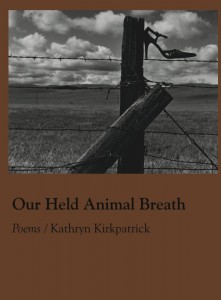
That's why the beginning of Kathryn Kirkpatrick's poem "Canning Globalization," from her collection titled Our Held Animal Breath, jumped out at me.
Not raised during the Depression I get it wrong.
Canning's not a thing you do
for fun or novelty.
It's what might go to waste out in the yard.
Figs and pears and muscadines.
Blueberries from a cousin's laden bushes.
It's readiness at the brimming,This is what I'm missing, this sense of urgency to preserve a gift that's already been given. Yes, the home-canned strawberry jam is ten times better than anything I can buy at the store, but it requires buying a flat of berries. I wait to buy the flat of berries until I know I'll have time to preserve them. I don't make the time, like I would if the berries were in my own yard staring at me.
a steadfast looking out
for what's been given.
Mother, teach me the boiling,Time has a funny way of not appearing. It just never seems to jump in out of nowhere, begging for something to be done with it.
the cooling and sealing,
how to live on these two acres,
squash vines on the upper hill,
raspberries in the sloping meadow.
In this era, time has become the most precious resource of all. The one thing that we never have in abundance. We hoard it, and waste it, and fly through it to the other side of a week, or a month, or a year, where we look back and wonder where it went.
Mother, teach me to let the jars stand and cool.What if we set aside a day to work together as a family to preserve the bounty of each season? I don't need to be taught how to do this--my parents showed me by example. I just need to decide it's important enough to prioritize, just for one day, over all the other things clamoring for my attention.
Let me peaceably fill my shelves
and bring on no one's calamity.
_______________________________________
The full poem, Canning Globalization, is about so much more than canning. It can be found in Kirkpatrick's collection titled Our Held Animal Breath. I received a copy of this book from TLC Book Tours so that I could write about it today.

