What are you reading right now? (And, is it good? Would you recommend it? How did you choose it?)
I have so many books on my bedside table right now, but the one sitting right here next to me is The Song of Achilles, by Madeline Miller. I had never heard of it (yep, I've been a little out of the loop) until Care announced a Read-Along. I'd been wanting to join a read-along but most of the ones I'd come across either didn't appeal to me (*cough*StephenKing*cough*) or I couldn't get the book in time (Quiet--I'm still sad about missing that one. I may have to do my own catch-up post when my library copy finally comes in).
Anyway--The Song of Achilles. So good! Miller interweaves her knowledge of history/the classics with a damned fine story. She intersperses just enough tidbits of the Greek language to keep the reader solidly rooted in Greece without overdoing it. And the characters! I've always liked Odysseus, but in this book he's actually one of my least favorite--which is not to say I dislike him, but that the others have come alive for me in such surprising ways. [There is still time to join the read-along. Care's first post will be this weekend, and the pages fly by so if you got the book today you will catch up quickly. I will most likely be posting updates on Worducopia's Facebook page as well]
Evan and I are on the final chapter of Little Women, and we are ready to move on, but as he says, "It's been a good long reading adventure." I already knew that I loved the book, having read it as a girl. But reading it with my boy has made me love him just that little bit more than I already did--for his appreciation of the humor in the language, and his recognition of the inherent sexism in some of Alcott's moralizing tangents, and most of all for his middle-of-the-book exclamation, "It's not that I want a ton of romance, but when are Laurie and Jo ever going to get together?!" Yes. But then it all works out, differently than a 12 year old expects it to but still perfectly, and there are life lessons in that which have lasted me into adulthood. What are you reading right now?
Evan and I are plowing through Little Women and having a great time of it. It's funnier than I remembered--or maybe some of the 1868 humor went over my head when I was a kid. Evan gets it, though.
One of the best things about reading aloud together (besides the quiet time snuggling all cozy under a blanket) is that he asks questions I wouldn't have thought to ask. I tend to breeze right over things I don't know, without even realizing it. Here are a few things we've learned.
What's a tin kitchen?
Jo's desk up here was an old tin kitchen, which hung against the wall. In it she kept her papers and a few books, safely shut away from Scrabble*, who, being likewise of a literary turn, was fond a making a circulatory library of such books as were left in his way, by eating the leaves.
*(Scrabble is the "pet" rat that lives in the attic)
A tin kitchen was used for cooking on the hearth. Meat would be placed inside on a spit, and the heat of the fire would enter through the open side and be reflected off the closed tin, making for quick and even roasting.
All the pictures I found of tin kitchens are rounded like the one pictured here. It seems like a rounded desk would be difficult for writing on! But I think that adds to the charm, and determination, of the little office Jo has set up for herself in the attic.
What did treadmill mean, back then?
"I dare say; but nothing pleasant ever does happen in this family," said Meg, who was out of sorts. "We go grubbing along day to day, without a bit of change, and very little fun. We might as well be in a treadmill."
As Evan pointed out, exercise gyms don't seem like the type of thing folks invested in, back in Civil War times. So what type of treadmill was Meg referring to? We found two different possibilities.
The first was an animal-powered device. Dogs, horses, or sheep could power a cream-separator, washing machine, churner, or saw. Similar treadmills have been used to train horses, or sled dogs for an Arctic expedition.
Treadmills were also used by humans, but not by choice. In Victorian-era prisons, prisoners were forced to walk for hours to grind grain. Something similar to a treadmill was also used as punishment, in which prisoners had to walk a certain number of steps in their cells in order to dispense their meals.
So, when Meg says she feels like she's on a treadmill, the commentary she's making about the life of a young woman without financial means is pretty darned glum. Poor Meg.
Who would have guessed that treadmills would be the wave of the future?
Source:Loudlit (Edgar Allen Poe, 1846) Date read: 2/4/13 Briefly: A man seeks revenge on an old friend for "a thousand injuries" he committed against him.
Afterthoughts: Ben was assigned to read this short story for English, so we listened to it together. Not being a big fan of horror, this is not something I'd ordinarily seek out. That said, though, it was deliciously creepy. Poe uses the setting of Carnival time in Italy, during which the protagonist, Montresor, lures a "friend" into the catacombs underneath his villa on the pretense of sampling some fancy Spanish sherry (Amontillado). Montresor has a scheme in mind, and by the end of this story, you'll be unlikely to follow any friends into the depths of their personal catacombs.
Apparently a short film was made of the this story in 2011.
Notable quotes: (The protagonist begins:)"Come, we will go back; your health is precious. You are rich, respected, admired, beloved; you are happy, as once I was. You are a man to be missed. For me it is no matter. We will go back; you will be ill, and I cannot be responsible. Besides, there is Luchesi --"
"Enough, the cough is a mere nothing; it will not kill me. I shall not die of a cough."
What else I'm reading:
I'm still working on the last two chapters of Flight Behavior. Also, Little Women, with Evan! So much fun to revisit this book I haven't read since I was, probably, ten? Evan was put off by the title at first, and he thinks there are too many sisters to keep track of, and it's awful thick! But overall he's enjoying it.
Find out what others are reading today at Book Journey's "It's Monday, What Are You Reading?"
I've loved all of Barbara Kingsolver's novels except for The Poisonwood Bible (which was actually the first of her books that I read, so obviously I didn't hate it since I went on to read more). So, I was thrilled to see she'd come out with a new one.
The Story: Dellarobia Turnbow is a young mother, living on her husband Cub's family sheep farm in Appalachia. On a walk up the mountainous side of their property, she discovers that their forest is, inexplicably, covered with monarch butterflies. This discovery draws the community to the farm to view what many see as a miracle. As word spreads, others arrive from farther way, including a team of scientists with their own perspective on the "miracle" (climate change) that has brought the butterflies to a region they've never been to before.
My bookmark is on page 156 of 433, which is early in chapter 7.
Thoughts: I was a little worried in chapter one, to be honest. Dellarobia was walking up the side of the mountain to meet up with a guy, and it was taking her the w-h-o-l-e chapter to walk up the hill, see that the trees looked weird (she wasn't wearing her glasses), decide not to meet with the guy, and walk down the hill again. Let's just say . . . I generally like a faster-paced beginning. This didn't bode well.
By the end of chapter two, though, things start happening. Most importantly, Dellarobia starts to find her voice and stand up to her domineering mother-in-law. By chapter 3 I was fully engrossed. Kingsolver writes a good story, and can make me laugh out loud on occasion.
There's one thing I've been grappling with, though. The characters, while definitely not at all flat, seem a bit typecast to me. I've never been to Appalachia, and Kingsolver grew up there, so obviously she knows these people and I don't. I often struggle with this in books set in the south, as well, so maybe it's just because people around here are so different in some ways. There are such stereotypes in the media, though, that I guess I would hope that a well-written book would break down those stereotypes for me instead of reinforcing them. I am hoping that some of the characters will surprise me by stepping out of their roles as the book continues. Knowing Kingsolver's skill as a storyteller, they probably will.
A favorite passage: My favorite scene so far is when Dellarobia invites the scientist, Dr. Ovid Byron, to dinner. She doesn't know he's a scientist. All she knows is that he came from far away to see the butterflies, he's black, and he has a Carribbean accent. She feels sorry for him because he's staying in the grossest motel in town. Over dinner, she proceeds to tell him everything she's learned on the internet about the butterflies, and then while listening to him talk to her five-year-old son, it becomes clear that he knows more than he's let on.
"You came here because you're one of the people who study these monarchs," she said.
"You are exactly right. I spent the day doing a quick census up there."
Quick, she thought, as in nine hours. Had he counted them all? "So, you do, what, experiments, or observations? And write up what you found out?"
He nodded. "A dissertation, articles, a couple of books. All on the monarch."
"A couple of books," she said to this man, recalling his look when she'd informed him, They're called monarchs. So, there were worse things than feeding meatloaf to a vegetarian.
Soundtrack: The soundtrack of the movie Cold Mountain comes to mind, both because the story is set in the same region, and because of the way the soundtrack fit in so beautifully with the movie and (by extension) Charles Frazier's book of the same title. For Flight Behavior, I'm going to pick Like a Songbird That Has Fallen, performed by Reeltime Travelers. It's not about butterflies, but close enough.
Find out what others are reading today at Book Journey
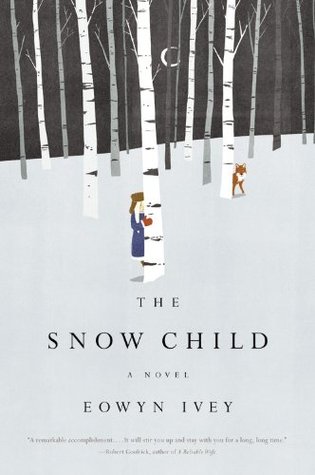
The Snow Child is one of this year's books for my book club. I think it's the book for March, so I'm a little ahead of myself, but it has such a winter theme that I wanted to read it during winter.
The story: Jack and Mabel are an older married couple attempting to homestead in the wilds of Alaska during the 1920s. Mabel wanted to start a new life together after spending ten years grieving the death of their only baby. One day, they spontaneously make a snowman (but it's a snowgirl, really) and the next day a little girl shows up.
My bookmark is on page 365 out of 538 in the large print version, which is the beginning of Chapter 35.
Thoughts: This book clearly draws on an old Russian fairy tale (which makes an appearance as a book Mabel remembers from childhood), but the way it's written is open to many interpretations, not all of which are magical. Plus, these are very realistic characters from a time in history that has always fascinated me, so it's kind of historical fiction, almost like a Little House on the Prairie book for grown ups. Mabel and Jack are working the land and trying to make it against all odds, as Alaskan homesteaders had to do. Their neighboring family, with it's no-nonsense husband and wife and three sons, has captured my heart more than the little girl has.
At first I thought it would be a slow novel, but it really draws me in, every time I pick it up. I love the characters, and the descriptions of the land. We don't get much snow in this part of Oregon, so it's lovely to sit on the couch looking out at the rain falling, and read about life in the lonesome, snowy woods, when neighbors stop by bearing dinner to share.
A favorite passage: (The neighbor, Esther, has arrived with dinner). "Should be enough chicken and dumplings for all of us. Lynx and dumplings, I should say, but it just doesn't have the same ring to it. Guess we could call it 'kitten and dumplings.'" Esther laughed and flung her coat across the back of a chair.
"Lynx? You've cooked a lynx?"
"Oh, don't make that face. Have you ever had it?Absolutely, positively the best meat you'll ever taste. Garrett had it live in a snare, so he killed it clean and brought home the meat. Guess we raised him up right after all."
Soundtrack: It's been a while since I've done a soundtrack for a book, but this song, River by Sarah MacLachlan, definitely came into my head during a particular scene, early on in the book. I like this video with its Wisconsin winter scenes, though it isn't Alaska, and the melancholy song goes perfectly with Mabel's mood at the beginning of the first winter.
Lately I'm more interested in the idea of keeping a reading journal than writing reviews. The difference, as I see it, is that a reading journal is ongoing, books-in-progress while a review feels more evaluative--the reviewer's final word on a book.
OK, the biggest difference is that for a reading journal, there's no requirement to finish the book before writing about it. Not that I'm (usually) trying to avoid finishing the books. I'm just more interested in writing about a book while I'm reading it. The book is at the front of my mind, I have all sorts of things to say about it, I'm composing entire paragraphs in my head, and then--I finish it. And...I'm kind of ready to move on.
The reading pile (okay: piles!!) calls to me. The book I'm writing calls to me. My kids and their schooling calls, too. I wish all the housework that needed to be done would call to me but it sits meekly in the corner with the dust bunnies saying, "That's all right, I know you're busy. I'll be fine over here the dark alone..."
Sometimes the book needs to go back to the library, so I can't use it to refer to while writing a review, but more often I can renew it and it sits there, waiting for me to either review it (clearly not so often, lately) or give up and finally return it so others can read it. Worse yet, when I own the book, it joins Housework in the corner with the dust bunnies and the guilt of yet another Review Unwritten.
I think I'll try the reading journal format and see how it goes. I'm currently alternating between two good books (A Great Feast of Light, by John Doyle, and The Snow Child by Eowyn Ivey). All I need to do is decide which one to write about first.