Showing posts with label guest posts. Show all posts

Monday, June 3, 2013

Even Cowgirls Get the Blues (A guest review by John Vorhaus)

I'm always interested to know which books end up as dog-eared copies on people's shelves, so I've taken to asking guest authors to write about a book they've loved. John Vorhaus, author of the Radar Hoverlander series, was happy to oblige. He chose a book by Tom Robbins, a bestselling author that, I have to admit, I've never gotten around to reading. After snickering my way through the John's hearty endorsement, I think I have to go ahead and give Even Cowgirls Get the Blues a try. Vorhaus's latest book, The Texas Twist, comes out this month.
________________________________________________________
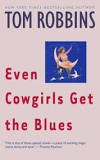

Hi there, Worducopians. John Vorhaus here, author of the new “sunshine noir” humorous mystery novel, THE TEXAS TWIST. Because writers are, first and foremost, readers, I thought you’d be interested to know what book has most informed my experience as an author. It’s Tom Robbins’ EVEN COWGIRLS GET THE BLUES, and if this modern classic has escaped your attention, you should put it on your must-read list immediately. If it blows your mind half as much as it blew mine when I first read it, why then it will have blown my mind twice as much as yours.

COWGIRLS notionally tells the story of Sissy Hankshaw, a white-trash lovely born with the affliction – or gift – of thumbs so large that she can have but one destiny, and that is to hitchhike her way around the world and into our hearts. On that level, the book works terrifically well. It delivers adventure, danger, thrills, laughs, romance, oddball characters, and enough food for thought to sate even the most questing head. But that’s not what the book is about, not really.
Because beneath the surface, COWGIRLS is subversive on two profound levels. The first is in the realm of social philosophy. Robbins, writing in the heart of the 1970s, takes the post-hippie ethos and turns it on its ear, delivering to us a way of looking at men and women, gay people and straights, native and invasive Americans, and the left and right ends of the political spectrum in a way that quickly moves past “Come on people now, smile on your brother,” and gets to the essential realization that each of us is the same, purely as a function of the hopes, dreams, tears, and fears that we all share. In our post-modern world of acceptance as the political norm, this might not seem so groundbreaking. Back then, it was nothing less than a revelation.

The other revelation COWGIRLS has in store is the powerful capability of modern English. In the hands of a master like Robbins, each sentence is not just an explication or an explanation, it is an adventure, a revelation, a happy journey to the magical wonderland where poetry and prose collide. You want an example? How about this bone-chillingly beautiful sculpting of words? “The author is attempting to draw a shaky parallel between the manner in which the oyster, when beset by impurities or disease, coats the offending matter with its secretions, thereby producing a pearl, a parallel between the eliminatory ingenuity of the oyster and the manner in which Sissy Hankshaw, adorned with thumbs that many might consider morbid, coated the offending digits with glory, thereby perpetuating a vision that the author finds smooth and lustrous.”

The eliminatory ingenuity of the oyster… Man, the first time I read that phrase I suddenly knew that there was much more to this business of writing than just communicating information or spewing the news. There’s art. There’s the potential for art in every word. And when that idea took root in my brain, I think I understood for the first time what it meant to be a writer. I knew what I wanted to achieve.

From that day to this, I’ve kept Tom Robbins in my heart and in my mind. I don’t consciously emulate him – who can consciously emulate genius? – but I do strive to be a worthy acolyte. That’s why when you read THE TEXAS TWIST, you’ll get not only a ripping yarn about the crosses and double-crosses that inform my world of con artists and their kind, you’ll also see evidence of my attempt to put color and spin in every sentence, to raise my prose to the level of art – if not to the level of Tom.
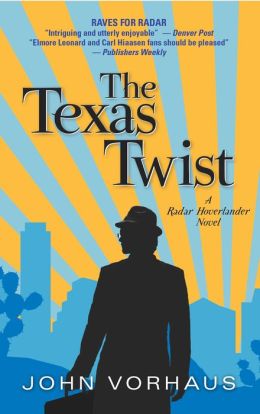


John Vorhaus’s new novel, THE TEXAS TWIST, is available now.. All his other books (and they are not few) can be found via his Amazon author page. He tweets for no apparent reason @TrueFactBarFact, and secretly controls the world from www.johnvorhaus.com.

Friday, October 12, 2012

Gone Girl--Gillian Flynn (Guest review by Tim Wuebker)

What happens when people with all of the brains, looks, charm, education, and pedigree in the world spiral into an unbelievable losing streak?

Amazing Amy is missing.  Amy is gorgeous, talented, self-disciplined, brilliant, and many men’s fantasy.  Yes, she is a mesmerizing beauty.  But she is also razor smart and always fun.  She’s a smart aleck: she doesn’t like women who boss their men around, and refers to those husbands/boyfriends as “dancing monkeys.”  They always show up and do the bidding of their wives, who apparently just like to see them jump.

What makes Amy so Amazing?  Her parents.  To a scary degree, Amy is a fictional character.  That is, her parents wrote twenty books for teens about her, the Amazing Amy series.  Except Amy’s parents wrote about the daughter they never had: Amy refracted through rose-colored lens—Amy if she were perfect.  When the real life Amy had trouble in school, Amazing Amy didn’t pout or cause problems.  She solved the problems with hard work and determination.  When real Amy lost the perfect boyfriend through her bad behavior, Amazing Amy won him back.  When real Amy lost her job as a premiere New York writer and her marriage got rocky, Amazing Amy….

It’s a lot of pressure, even for a gorgeous girl with near perfect SATs to live up to.  Real Amy made mistakes.  But Amazing Amy always lands on her feet with panache and good cheer!

And now Amy’s gone.  Maybe dead.

Who kidnapped or killed her?

Part One alternates between Amy’s diary (covering the last five years) leading up to her disappearance, and the story of her husband’s life starting with Day One of the missing girl investigation. 

Nick is charming, an adjunct college professor, the co-owner of The Bar (paid for with Amy’s trust fund), and—once you get past his easy glamour--everyone’s idea of the least sympathetic husband on earth.  He’s also hyper self-aware, so he knows all of his flaws.  He even knows that his self-awareness isn’t born of humility, but of narcissism.  Nick can’t stomach criticism, and he wants everyone to always think the best of him.  So, he withholds information, and not just from the cops or his twin sister, but from us: the readers. 

When he’s finally forced to admit to a devastating revelation, he tells us in advance that he’s about to say something that will make us hate him.   Hate him.   Abhor him; wish evil upon him.  And his admission sort of works: you know he may be guilty of murder, but you hope he isn’t.  You know he’s a selfish liar who has hurt others, but you root for him anyway, just like maybe you rooted for Sherman McCoy in Bonfire of the Vanities.

I would love to tell you more, but I can’t.  Because the author, Gillian Flynn, is absolutely in control of every element of the story. 

One third of the way in, Ms. Flynn hit me so hard with a shocking surprise that I never would’ve guessed it if I’d taken out a sheet of paper and you’d paid me $100 for every hypothetical plot twist I could have come up with.  Believe me, I would have listed at least $20,000 worth, and none of them would have been as good as what Gillian Flynn unveiled.

Let’s just say that Flynn is highly deceptive.  If fiction is about misdirection, then I hope Ms. Flynn lives to be the oldest woman in the world and writes a book a year, because once the major surprise hit, I was destabilized. 

I couldn’t read fast enough.  Then she shocked me again.  Several times.

When an author is this adept at plot and twists, it’s easy to race through a book and not appreciate the depth of the characterization.  But Flynn shows so many sides to her complex characters, Nick and Amy, that when I finished Gone Girl, I wanted to start over.  I wanted a sequel.

Plot.  Three-dimensional characterization.  Powerful language.  And a devastating portrayal of setting: America, post 2009.  More than just the economy crashes in Gone Girl.  When people’s hopes get shredded, so does their veneer of being civilized people: the charm goes, and they act out of their rawest wounds, all claws and teeth, lashing out even when they know it’s self-destructive, caught in a death spiral, all the while feeling they withdraw and regroup from what they are doing, but if Gone Girl illustrates one principle of psychology with total veracity, it’s that our emotions are so much more powerful than our reason.

I only wish one thing were different: the ending.  That’s why I think: sequel. 

There’s also foul language, sexual depravity, and a portrayal of porn as a mainstream behavior.   But maybe parts of our society are already there.  And taken within the context of Flynn’s dark vision, these NC-17 elements make sense, but readers deserve a fair warning.

If you like buying mysteries or contemporary novels for friends, I’d give them Gone Girl.  The plot alone is worth it, but what Flynn does with psychology and setting is masterful.  I am thrilled that Ms. Flynn has two novels I haven’t read: Dark Places and Sharp Objects.  They’re next.
-------------------

Tim Wuebker is an author from the greater Kansas City area. He's also a teacher who has had students from every continent, facilitated 11 kinds of college English classes, and taught six kinds of high school math. His latest novel, 2029, is a thriller available for Kindle on Amazon.  Find Tim on Facebook at https://www.facebook.com/timwwuebker.

Thursday, September 10, 2009

Books to look forward to (Guest post: Kailana of The Written World)

While I'm away, Kailana of The Written World offered this guest post. Her thoughts about fall releases are perfectly timed for me, because I'm just starting to feel a hint of autumn here in Oregon as I prepare for my family's annual fall trip to the San Juan Islands in the Puget Sound off of Washington state. I'll be back in time for Book Blogger Appreciation Week on the week of September 14th.

For me, fall is the best time of the year. It's almost always when the books I have been looking forward to all year are going to be released. I also enjoy hearing what other people are waiting for, so I thought I would do my post on that very topic. There are several books I am looking forward to, but here is just a list of a few of them:

Her Fearful Symmetry by Audrey Nieffenegger - Released October 6, 2009
By the author of The Time-Traveler's Wife, this is probably the book I am most looking forward to this fall. It's been 5 years, so it is exciting that she finally has a new book out. Plus, it is already getting good reviews!

From Amazon.ca:
Another brilliant, original and moving novel from the author of The Time Traveler’s Wife.

Julia and Valentina Poole are normal American teenagers — normal, at least, for identical “mirror” twins who have no interest in college or jobs or possibly anything outside their cozy suburban home. But everything changes when they receive notice that an aunt whom they didn’t know existed has died and left them her amazing flat in a building by Highgate Cemetery in London. They feel that at last their own lives can begin … but they have no idea that they’ve been summoned into a tangle of fraying lives, from the OCD-suffering crossword setter who lives above them to their aunt’s mysterious and elusive lover who lives below them, and even to their aunt herself, who never got over her estrangement from the mother of the girls — her own twin — and who can’t even seem to quite leave her flat….
The Maze Runner by James Dashner - Released October 6, 2009
I saw this book being discussed on Twitter and knew I was going to have to give it a read when it comes out. I have only seen positive reviews, but I don't know if I will buy it myself or see if the library will get a copy.

From Amazon.ca:
When Thomas wakes up in the lift, the only thing he can remember is his first name. His memory is blank. But he’s not alone. When the lift’s doors open, Thomas finds himself surrounded by kids who welcome him to the Glade—a large, open expanse surrounded by stone walls.

Just like Thomas, the Gladers don’t know why or how they got to the Glade. All they know is that every morning the stone doors to the maze that surrounds them have opened. Every night they’ve closed tight. And every 30 days a new boy has been delivered in the lift.

Thomas was expected. But the next day, a girl is sent up—the first girl to ever arrive in the Glade. And more surprising yet is the message she delivers.

Thomas might be more important than he could ever guess. If only he could unlock the dark secrets buried within his mind.
Peter & Max: A Fables Novel by Bill Willingham & Steve Leialoha - Released October 13, 2009
I am a huge fan of the Fables series by Bill Willingham, so when I heard they were making a novel version I put it on my wish list immediately. I am a little worried because this is new territory for them, but I am confident they can pull it off.

From Amazon.ca:
A new stand-alone FABLES NOVEL from award-winning and wildly acclaimed author, Bill Willingham.

This story stars Peter Piper and his incorrigible brother Max in a tale about jealousy, betrayal and revenge. Set in two distinct time periods, prepare to travel back to medieval times and learn the tragic back-story of the Piper family, a medieval-era family of traveling minstrels. Then, jump into the present to follow a tale of espionage as Peter Piper slowly hunts down his evil brother for a heinous crime, pitting Peter's talents as a master thief against Max's dark magical powers.

Based on the long-running and award-winning comic book series FABLES, PETER AND MAX is its own tale. Readers don't have to be familiar with the comics to fully enjoy and understand this book.
Fire by Kristin Cashore - Released October 6, 2009
I was going to leave this one off because it's part of a series. The list just looked barren without this one, though, so I am adding it on. Besides, you have a month to read the first book, so I recommend doing so if you haven't already! It is called Graceling.

From Barnes & Noble.com:
She is the last of her kind...

It is not a peaceful time in the Dells. In King City, the young King Nash is clinging to the throne, while rebel lords in the north and south build armies to unseat him. War is coming. And the mountains and forest are filled with spies and thieves. This is where Fire lives, a girl whose beauty is impossibly irresistible and who can control the minds of everyone around her.

Exquisitely romantic, this companion to the highly praised Graceling has an entirely new cast of characters, save for one person who plays a pivotal role in both books. You don't need to have read Graceling to love Fire. But if you haven't, you'll be dying to read it next.

Going Bovine by Libba Bray - Released September 22, 2009
I loved her first trilogy, so I was thrilled to see she had a new book out! She has a tough debut to follow, so fingers crossed this book is worth the wait!

From Amazon.ca:
Can Cameron find what he’s looking for?

All 16-year-old Cameron wants is to get through high school—and life in general—with a minimum of effort. It’s not a lot to ask. But that’s before he’s given some bad news: he’s sick and he’s going to die. Which totally sucks. Hope arrives in the winged form of Dulcie, a loopy punk angel/possible hallucination with a bad sugar habit. She tells Cam there is a cure—if he’s willing to go in search of it. With the help of a death-obsessed, video-gaming dwarf and a yard gnome, Cam sets off on the mother of all road trips through a twisted America into the heart of what matters most.
That's just some of the books I am looking forward to this season! What about you, what are some books that you are looking forward to? I can always use more books on my wish list, right?

Wednesday, September 2, 2009

When Setting is Character (Guest Post: Mattox Roesch)

Mattox Roesch wrote this piece for me when I asked him to write about the cultural milieu of his book, Sometimes We're Always Real Same-Same, which takes place in a tiny town in Alaska. Talk about a town being a character--I felt completely enveloped by Unalakleet and its unique citizens as I read the book. Roesch's essay about his adopted hometown filled me with nostalgia for a tiny place I've never been to, except through his fiction.

Our town is getting paved roads. “Finally,” some people say. Kids carrying skateboards to the only skateable square of concrete have told me, “Man, I can’t wait!” And when they make plans with me to skate some busted piece of something, I tell them, (in my best attempt at not sounding like a man-child), “Dude, I’m there.” But I’ve heard a handful of less enthusiastic reactions to the paved roads rumor. Some Why?’s. Some Big Deal’s. And a whole bunch of I’ll believe it when I see it’s. And I can understand the cynicism as well.

For hundreds of years, since before the first Russian-American trading post opened up in Unalakleet in the 1830’s, since before a tuberculosis outbreak wiped out many of the townsfolk, since before the village was on the south side of the river, people have existed here without pavement. It was one of the first things I noticed as a newcomer six years ago—gravel roads. And recently, while flipping through the pages of my Unalakleet-based novel, looking for passages to read at my upcoming event at Annie Bloom’s Books, I noticed, There’s a lot of gravel in this book. And there is. There is a lot in town, too. On dry days, every pickup or four-wheeler sends a cloud of gravel through every screen window and every bike-riding adolescent’s lungs.

This whole thing is interesting to me because I grew up accepting pavement as a given. But my wife, on the other hand, grew up here. She remembers when there was no TV in Unalakleet, and then just one channel, and now, satellite dishes bolted to almost every home. She remembers dialing only four-digit phone numbers, and she’s only thirty-two years old. Her gram remembers a time before vehicles. Her gram remembers hunting and fishing and collecting everything the family ate. “Progress” has happened a lot more quickly here than in the rest of the country. And people have experienced many gravel-road-type rumors, and many gravel-road-type “improvements.” It is a major part of the village’s collective experience—this thing we call “progress”—and now I’m here to experience a part of the excitement and the ambivalence of modernization.

My wife’s gram is very quick to praise innovations like the washing machine and refrigerator/freezer and stove. She’s told me of how much time and energy subsistence living took, especially without those amenities. But these days, she doesn’t have an opinion about paved roads, because her memory is failing. She often asks for her mother and confuses her daughters for her sisters. But, despite her Alzheimer’s, she still loves to laugh. Last weekend we were all picnicking together upriver, and as the food was settling and the stories started flying, one cousin shared an anecdote that sent my wife and all the aunties laughing hysterically. Gram didn’t hear the story, because her hearing is bad, but she busted out laughing with all the ladies anyway. Gram said, “I don’t even know why you’re laughing, but I laugh along with you.” We’ve all heard this a hundred times. We all laughed anyway and kept telling more stories.

Our town is getting paved roads. But despite the pavement, I think progress is still happening here all the time. It’s just like anywhere else.

Roesch will be doing a reading in Portland at Annie Bloom's bookstore on Thursday at 7:30. If you're in the area and haven't read Sometimes We're Always Real Same-Same (released today!), I highly recommend heading over there and getting a taste of the prose. Wish I could go!

On Korea (Guest Post by Softdrink)

Jill of Fizzy Thoughts wrote this guest post, inspired by the Diversity Roll Call Around the World question. Thanks, Jill!

I am currently reading The Calligrapher’s Daughter. Written by the talented Eugenia Kim, it is set in Korea in the early 1900s, a politically turbulent time in Korea’s history.

Since I pretty much know squat about Korean history (other than the fact that M*A*S*H was set there during the Korean War), I decided to do a little research. Now granted, this research is mostly comprised of info from www.korea.net and Wikipedia, but hey…it’s a start.


Korea is located in Asia, just west of Japan:


It’s that small yellow country in the top right of the map. The one without a name. How rude.


Korea actually has a long history. And since I used to be a history teacher, I can’t resist the opportunity for a little history lesson.


Way back in 2333 BC Dangun united many of the warring tribes of the Korean peninsula to found Gojoseon. This date is generally regarded as the beginning of Korean history. Gojoseon fell in 313 and several smaller kingdoms emerged. In 918 Wang Geon united these kingdoms and founded the Goryeo Dynasty, from which the name Korea is derived. The Goryeo Dynasty marks the beginning of a tradition of a strong central government and political and cultural independence that survived until 1910.


In 1392 the Joseon Dynasty replaced the Goryeo Dynasty and introduced Confucianism as the guiding philosophy of the kingdom. Civil service exams allowed for social mobility and emphasized learning. In the 1400s court scholars created Hangeul, the Korean alphabet. Invasions by both the Japanese and the Manchurians were successfully repelled. By the 1800s Korea had become known as the “Hermit Kingdom” due to its resistance to demands for diplomatic and trade relations.


However, in 1910 Korea was forcibly annexed by Japan, which adopted a policy of cultural assimilation. It outlawed the Korean language and gave preference to Japanese for many jobs. On March 1, 1919 a peaceful demonstration for independence was brutally squashed. During this same period, many members of the Korean royal family died under suspicious circumstances and the Joseon Dynasty came to an end. Life only got rougher during WWII. Beginning in 1939 over 5 million Koreans were conscripted for labor. And over 200,000 Chinese and Korean women, known as “comfort women,” were forced into sexual slavery for the Japanese military.

After WWII North Korea was occupied by Soviet forces, while US forces occupied the South. The UN Commission planned general elections, but since the Soviet Union denied access to North Korea the elections were never held there. South Korea elected Syngman Rhee as its first president, while North Korea established a communist state under Kim Il-sung.


War broke out in 1950 when North Korea, backed by the Soviet Union, invaded South Korea. After three years of fighting a cease fire was called and the peninsula remained divided into two countries. The demilitarized zone, or DMZ, marks the boundary between the two countries. It is still heavily patrolled by the military, including US forces. Today North Korea remains a communist state under the leadership of Kim Jong-il, the son of Kim Il-sung. It has a completely nationalized economy with a heavy focus on military and nuclear arms. South Korea is a democratic republic with a strong economy. It has focused on high-tech industries, although it also maintains a large army.


Flag of North Korea


Flag of South Korea:


Some additional facts:

  • In Korea, the family name is placed first.
  • Koreans are considered 1 year old when born.
  • In 1234, during the Goryeo Dynasty, the world’s fist moveable metal type was invented.
  • The yangban class was the traditional ruling class of the Joseon Dynasty. It exemplified the Confucian ideal of the “scholarly official” and relied on the slave labor of the lower classes to enjoy the life of scholarly gentlemen.
  • Despite the cease fire of 1953, a peace treaty was never signed. Therefore, North and South Korea are still officially at war.

Besides The Calligrapher’s Daughter, here are a few other novels set in Korea:

The Red Queen, Margaret Drabble

Jia, Hyejin Kim

Year of Impossible Goodbyes, Echoes of the White Giraffe and Gathering of Pearls, Sook Nyul Choi

And a non-fiction book that looks interesting:

Korea: A Walk through the Land of Miracles, Simon Winchester

Saturday, August 29, 2009

Great bestsellers by 1940s novelists you probably never heard of
(Guest Post by Linda Gorton Aragoni)

I'm sipping tea in a lakeside cabin in New Hampshire. In my absence, Linda Aragoni was kind enough to write a guest post focusing on some great books from another era. Linda is an educational communicator whose work includes the website YouCanTeachWriting.com. For fun, she reviews bestsellers of 50 or more years ago on their anniversary years at GreatPenformances.wordpress.com.

The 1940s produced some wonderful novels, including some by novelists whose bestsellers have been all but forgotten. Here are are 10 novels from that decade’s bestseller list that are worth digging out today.

The Family (1940 #10). Russian ex-pats in Tientsin, China run a boarding house for a rag-tag assortment of people of various nationalities. Nina Fedorova writes with wit and sensitivity about the struggles of people whose lives consist mainly of looking for work and doing without.

Many novels tell about how slavery degraded slaves. The Sun Is My Undoing by Marguerite Steen (1941 #4) tells about how slavery degraded the slave traders. A mediocre novelist couldn’t have envisioned a story whose lead character is a slave trader, let alone written it.

In 1900, Kings Row was a good place to raise raise children. Author Henry Bellamann takes us behind the lace curtains of the little Midwestern town for a different view. When you read Kings Row (1942 #9), you don't just imagine it happening: you stand beside its lead character and experience it.

Mrs. Parkington (1943 #6) celebrates the art of growing old by living every day well. Mrs. Parkington, 84, is the very rich widow of a larger-than-life scoundrel whom she adored. As she puts her affairs in order, events trigger memories through which Louis Bromfield lets readers see how an innocent Nevada lass became an indomitable woman.

Strange Fruit
by Lillian Smith (1944 #1) is a simple love story in a setting where nothing is simple. Nonnie is black, Tracy is white, and they live in 1940s Georgia. Lillian Smith shows that the most important factor in race relations in America is human choice.

Thanks to Adria Locke Langley’s decision to let Verity Martin tell the story of her charismatic husband’s political career, A Lion Is in the Streets (1945 #7) is a political novel the a-political can enjoy. Much of the plot has to be grasped from innuendo. You’ll need to read slowly, picturing the scenes, but the novel is worth the effort.

Mary Jane Ward’s The Snake Pit (1946 #10) takes readers inside the mind of mental patient Virginia Cunningham as she tries to cope with ordinary tasks that seem hopelessly beyond her. In a quiet way, The Snake Pit is as terrifying as anything by Stephen King.

House Divided by Ben Ames Williams (1947 #7) follows the Currain family of Virginia as they attempt live down the shame of distant kinship to “the black ape,” Abraham Lincoln. Williams produces believable characters, high drama and superb dialogue, all resting on an extensive base of facts of the War Between the States.

The Young Lions by Irwin Shaw (1948 #10) is a superbly plotted novel about three solders in World War II: a cultured German, an American Jew; and a clumsy, idealistic American playwright. War defines and intensifies each one's essential nature. There are no stereotypes, no heroes or villains from central casting. The men are so distinctive, you feel almost as if you actually knew them.

In The Point of No Return (1949 # 4), John P. Marquand explores the one time in his life when investment banker Charles Gray almost stepped out of character. Marquand is so skilled a writer that he makes an entertaining novel out of experiences that didn’t excite even their participants.